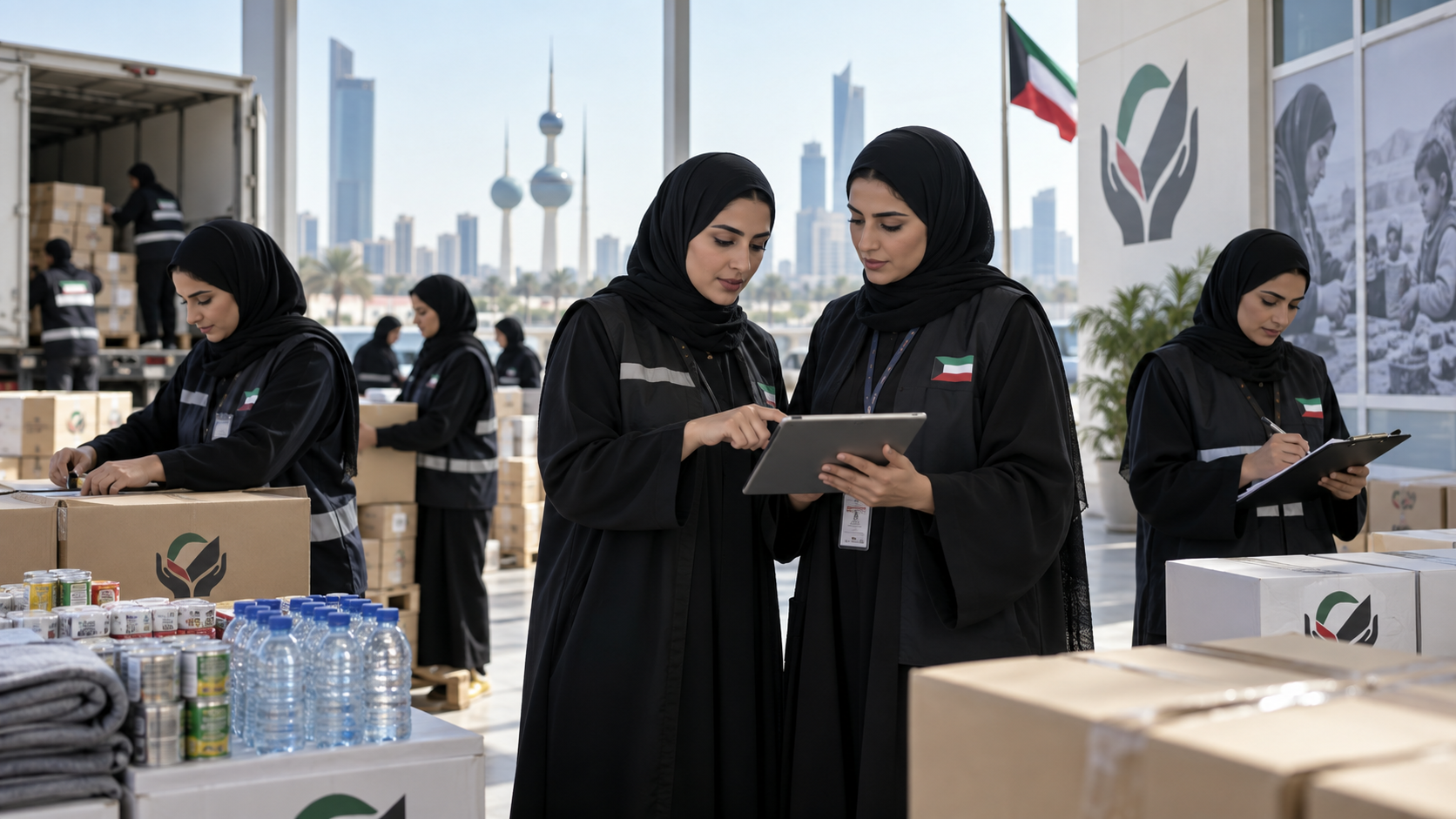
Kuwaiti women have consistently advanced their participation in humanitarian and voluntary sectors, progressing from localized community initiatives to structured national contributions. Today, women represent roughly 74.5 percent of the personnel in Kuwait's relief sector, while occupying 26 percent of leadership roles in charitable associations and holding 25 percent of their board seats.
This evolutionary shift has been bolstered by nationwide policies, including the 2004 Amiri Decree that established the Volunteer Work Centre. This decree helped institutionalize community service, provided specialized training, and promoted public involvement. Historically, women's involvement dates back to the foundations of Kuwait, where they contributed to religious endowments, Quranic schools, health initiatives, and educational institutions. Historical records show that more than 80 Kuwaiti women volunteered to set up and manage traditional schools, while women accounted for approximately 224 of the 440 registered charitable endowments of that era.
Sheikha Amthal Al-Ahmad Al-Jaber Al-Sabah, Chairperson of the Volunteer Work Centre, explained that the spirit of giving is rooted in Kuwait's cultural traditions of mutual support. Highlighting early historical cooperation, she referenced the building of Kuwait's third defensive wall, during which men worked on construction while women supplied water and prepared meals. She also noted past contributions such as Sabeeka Al-Khaled donating her home to expand Al-Mubarakiyah School, and Shaha Al-Hamad Al-Saqer donating a shop to accommodate the National Library.
Sheikha Amthal recalled that Kuwaiti women traveled in a delegation to Egypt in 1956 to volunteer in hospitals during the Tripartite Aggression. She added that women actively supported the domestic resistance during the Iraqi invasion. Highlighting the link between education and community service, she praised educational pioneers like Maryam Abdulmalek Al-Saleh, Kuwait's first female teacher, and Lulwa Al-Qatami, who later served as the head of the Women's College at Kuwait University. The Volunteer Work Centre has since drafted a national volunteering strategy and launched a digital volunteer platform.
Lulwa Al-Qatami, honorary chairperson of the Women's Cultural and Social Society, recounted how she co-founded the association in the 1960s with Fedha Al-Khaled. The organization's early local initiatives included launching literacy classes for women, establishing the free Al-Bustan Nursery in Kaifan for children of working mothers, and organizing street-cleaning campaigns. Globally, the association established the "Kuwaiti Hanan Village" in Kassala, Sudan, to care for children and drill water wells, set up a village for displaced Palestinian children in Lebanon, and supported educational initiatives in Jerusalem. After the 1967 war, members also organized the "Warrior's Bag" initiative to deliver personal necessities to soldiers in the Golan Heights.
Sabeeka Al-Jasser, Chairperson of the Kuwait Society for the Care of the Disabled, concluded that the involvement of Kuwaiti women goes beyond simple donations. She emphasized that modern volunteering is a structured national responsibility aimed at empowering vulnerable groups and securing their rights to education and societal independence.