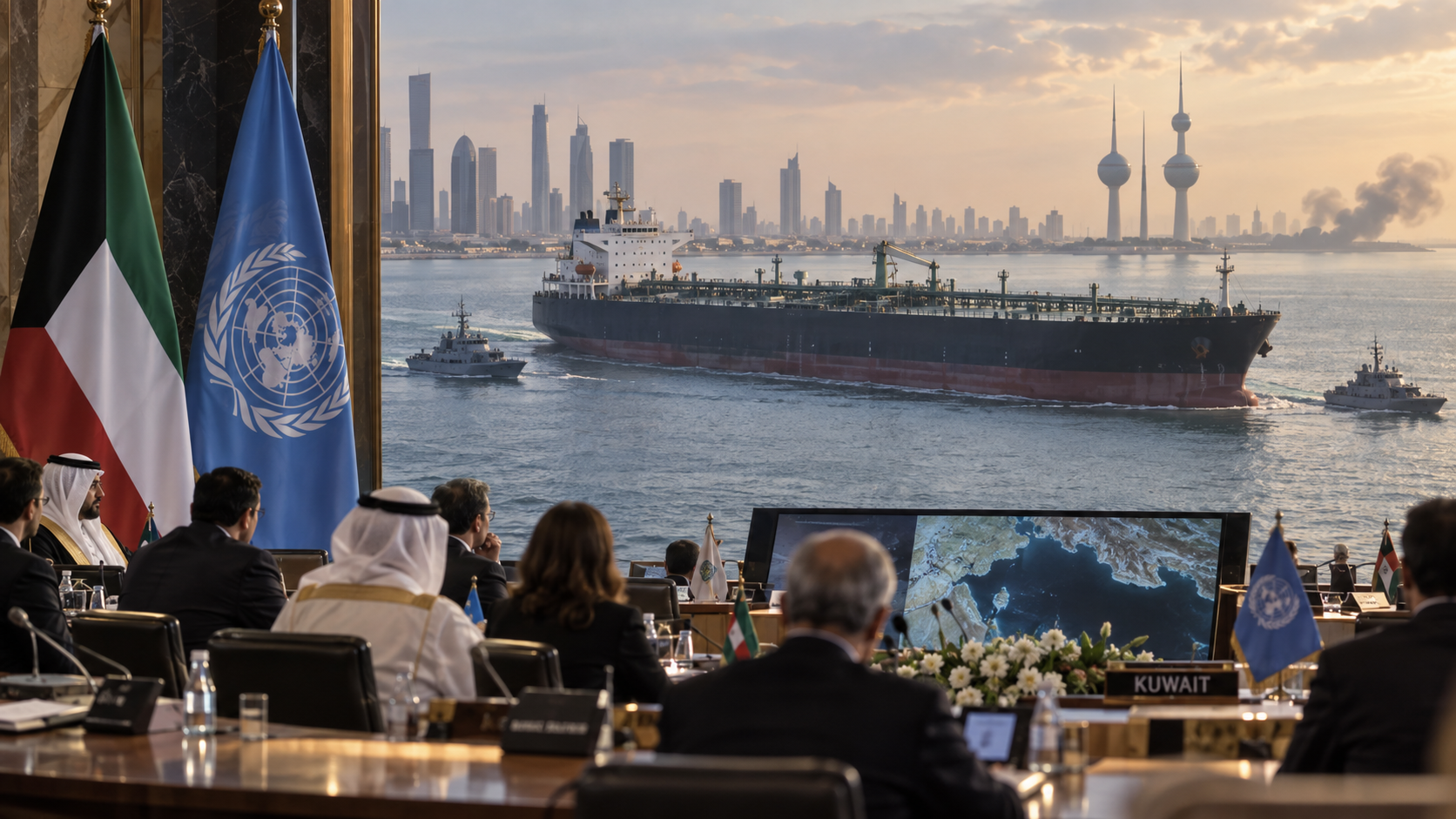
Kuwait has used a session of the United Nations Human Rights Council in Geneva to warn that attacks on oil tankers can create serious environmental risks and threaten the right to life, framing maritime security as a human-rights issue as well as a question of international humanitarian law.
Dr. Nada Al-Dhebaib, a diplomat with Kuwait’s Permanent Mission to the United Nations Office in Geneva, delivered the statement during the general debate under item three of the Human Rights Council’s 63rd session. The account was distributed by Kuwait News Agency (KUNA) and carried by Kuwait Times, Al-Rai and other Kuwaiti outlets.
Al-Dhebaib said that targeting oil tankers represents a serious violation of international humanitarian law and warned that damage to ships carrying petroleum products could have consequences beyond the vessels themselves. In Kuwait’s presentation, the environmental effects of such attacks can threaten human life and therefore intersect directly with fundamental human-rights protections.
The statement did not identify a particular tanker attack, name an alleged perpetrator or present evidence about a specific maritime incident. Gulf Pulse is therefore treating it as a policy and legal position expressed by Kuwait at the UN forum, not as confirmation of responsibility for any individual attack.
The Kuwaiti diplomat used the tanker issue as part of a broader argument about the indivisibility of human rights. She called for civil, political, economic, social and cultural rights to be considered together with the right to development, rather than handled selectively or in isolation.
According to the KUNA account, Al-Dhebaib argued that stable and equitable development is an important foundation for protecting human dignity. She also renewed Kuwait’s support for international cooperation based on constructive dialogue and called for human-rights issues to be addressed without politicization, discrimination or double standards.
That wider framing is significant because oil-tanker incidents can affect several areas at once. A maritime attack can create immediate risks to crews and coastal communities, while a spill or fire can produce environmental damage and disrupt trade or energy flows. Kuwait’s intervention focused specifically on the human-rights consequences of that chain of risk.
The statement was made in the Human Rights Council’s general debate under item three, which concerns the promotion and protection of human rights. Kuwait’s intervention linked environmental harm to the right to life and placed maritime attacks within a wider discussion about how security, development and human dignity intersect.
Multiple Kuwaiti outlets carried the same KUNA-originated account. Al-Rai reported the statement on September 18, while Kuwait Times published an English-language version on September 19. Al-Jarida also carried the remarks in Arabic and identified Al-Dhebaib as a member of Kuwait’s permanent delegation in Geneva. The consistency of these accounts supports the wording and institutional setting of the statement, although they derive from the same official KUNA reporting chain rather than from separate eyewitness reporting.
For editorial accuracy, Gulf Pulse is retaining Kuwait’s legal characterizations as attributed statements. Whether a specific attack constitutes a violation of international humanitarian law in a particular case can depend on facts such as the target, circumstances, intent and applicable legal framework. This article does not make an independent legal determination.
The confirmed news value is Kuwait’s decision to raise the risks associated with attacks on oil tankers before the UN Human Rights Council and to connect potential environmental damage with the right to life. The statement also reinforces Kuwait’s broader call for comprehensive human-rights protection and international cooperation.
No additional operational details, casualty figures, spill estimates or identification of a specific vessel were included in the available statement. Those details should not be inferred. Any later reference to a named tanker or incident would require separate source verification before being added to the story.