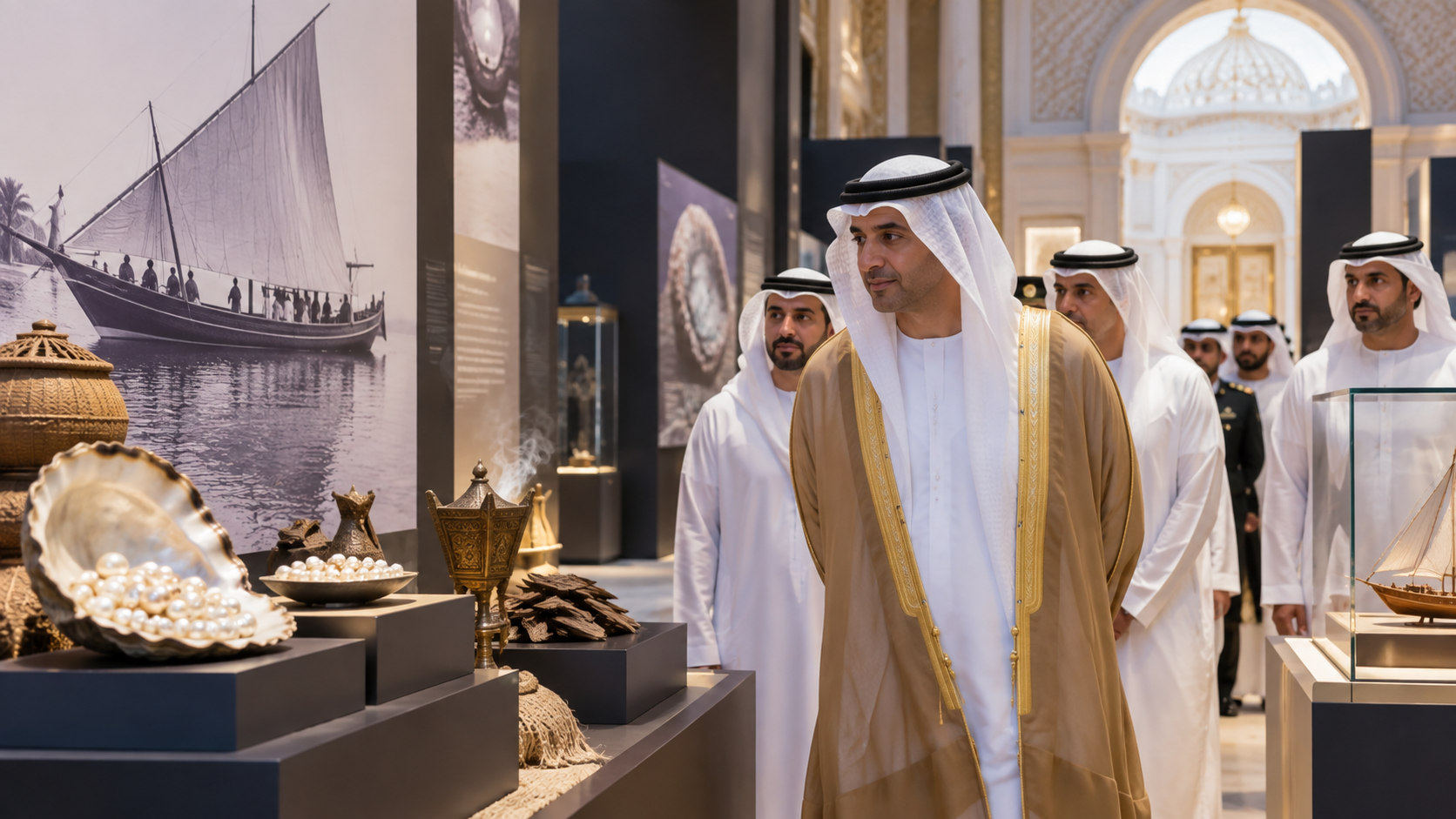
Sheikh Mansour bin Zayed Al Nahyan, Vice President, Deputy Prime Minister and Chairman of the Presidential Court, has inaugurated a new Qasr Al Watan exhibition exploring the historical role of pearls, oud, amber and maritime trade in the UAE.
The exhibition, titled “Emirates of Pearls and Aromas: A Deep-Rooted Legacy, Shaping the Future,” is designed to connect cultural heritage with the economic history of the region and to show how trade, the sea and traditional industries shaped communities before the oil era.
During a tour of the exhibition, Sheikh Mansour was briefed on sections examining pearl diving, aromatic materials and the maritime networks that linked the Gulf with trading centres across Asia and North Africa.
He said the UAE’s geographic position historically placed it on major routes between East and West, helping turn the area into a meeting point for merchants, travellers and cultures.
The exhibition presents the sea as more than a physical setting. For coastal communities, maritime routes supported trade, fishing, pearl diving and contact with markets in India, China, Iraq and North Africa. WAM also highlighted the historical importance of sites such as Dalma, Sir Bani Yas and Umm Al Nar in the country’s long commercial and civilisational development.
Pearls occupy a central place in the exhibition because they were an important pillar of the pre-oil economy. Pearl diving supported families, merchants and seafaring communities, while connecting the Gulf to international markets.
Oud and amber are presented through a different but related lens. Both have long held cultural, social and commercial significance in the region, with their use linked to hospitality, personal tradition, trade and ceremonial life.
The exhibition also examines shipbuilding, which made the wider maritime economy possible. Traditional vessels were essential to pearl diving and long-distance trade, and they helped connect communities across the Arabian Gulf and Indian Ocean.
Qasr Al Watan said the exhibition is intended for a broad audience that includes researchers, students, heritage specialists and visitors with a general interest in Emirati history. The format combines objects, interpretation and immersive experiences rather than presenting heritage as a purely academic subject.
The exhibition also reflects a wider UAE policy of preserving national heritage while presenting it in contemporary cultural institutions. That approach can be seen across museums, heritage districts, archaeological programmes and initiatives documenting traditional crafts and oral history.
Sheikh Mansour linked the historical themes to the UAE’s continuing role as a trading and cultural gateway. The emphasis is on continuity: older maritime routes and commercial traditions are presented as part of a longer story of openness and exchange rather than as an isolated historical period.
Qasr Al Watan is expected to announce public visitor access to the exhibition separately. Until those details are issued, the inauguration marks the formal launch of the cultural programme rather than the start of general admission.