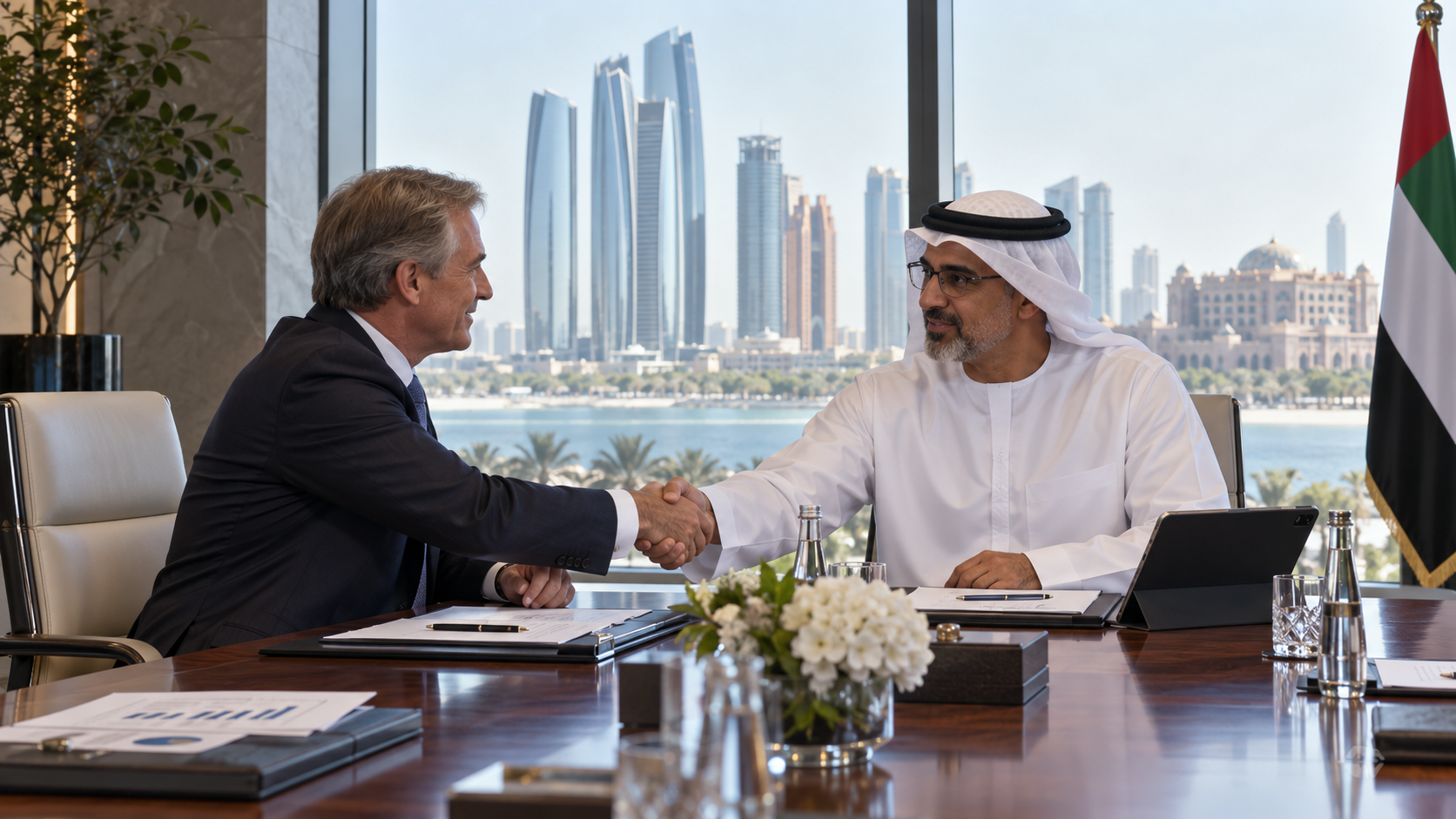
UAE Minister of State Saeed Al Hajeri and Lord Mervyn Davies, Co-Chair of the UAE–UK Business Council, have held talks in Abu Dhabi on expanding private-sector cooperation and identifying new trade and investment opportunities.
The meeting at the UAE Ministry of Foreign Affairs was the second between the two co-chairs since they assumed their roles.
Their discussions focused on the strategic role of the UAE–UK Business Council in connecting companies, investors and institutions from the two countries.
Both sides examined opportunities to deepen cooperation in artificial intelligence, healthcare, tourism, culture and hospitality, according to the Ministry of Foreign Affairs and WAM.
The emphasis on sector-specific cooperation reflects the council’s role as a business platform rather than a government negotiating body. Its work is intended to connect companies with opportunities and help identify barriers or areas where closer commercial coordination could be useful.
Al Hajeri and Davies also discussed preparations for the next UAE–UK Business Council plenary meeting, scheduled to take place in London in October 2026.
That meeting is expected to provide a larger forum for companies and institutions to review priority areas of cooperation and identify potential projects.
The Abu Dhabi discussions also covered the UAE’s network of Comprehensive Economic Partnership Agreements with international partners, together with the country’s free zones, logistics infrastructure and manufacturing capabilities.
The UAE side presented those assets as tools that British companies can use to expand operations in the Emirates and reach wider regional markets.
The meeting also looked ahead to the council’s priorities for the remainder of 2026 and into 2027, suggesting that the co-chairs are setting a medium-term work programme rather than focusing on a single transaction.
Al Hajeri and Davies first met in their new co-chair roles in August. At that stage, they discussed the council’s future direction and the broader UAE–UK economic relationship.
The council sits alongside formal government-to-government economic ties but is focused particularly on private-sector engagement.
No new trade agreement or investment value was announced at the September meeting. The immediate outcome was agreement on priorities and preparations for the London plenary.
The significance of the process will therefore depend on company participation and whether the council can translate its sector priorities into concrete investments, partnerships and market access.
Artificial intelligence and healthcare are likely to attract particular attention because both require a mix of technology, finance, regulation and specialist expertise. Tourism, culture and hospitality offer a different set of opportunities linked to services, investment and destination development.
For UAE companies, the council can provide access to UK partners and expertise. For British businesses, the UAE’s logistics and investment platforms can provide a base for activity across the Gulf and wider region.
The October plenary will be the next major checkpoint for assessing how the priorities discussed in Abu Dhabi are being developed into a practical agenda.