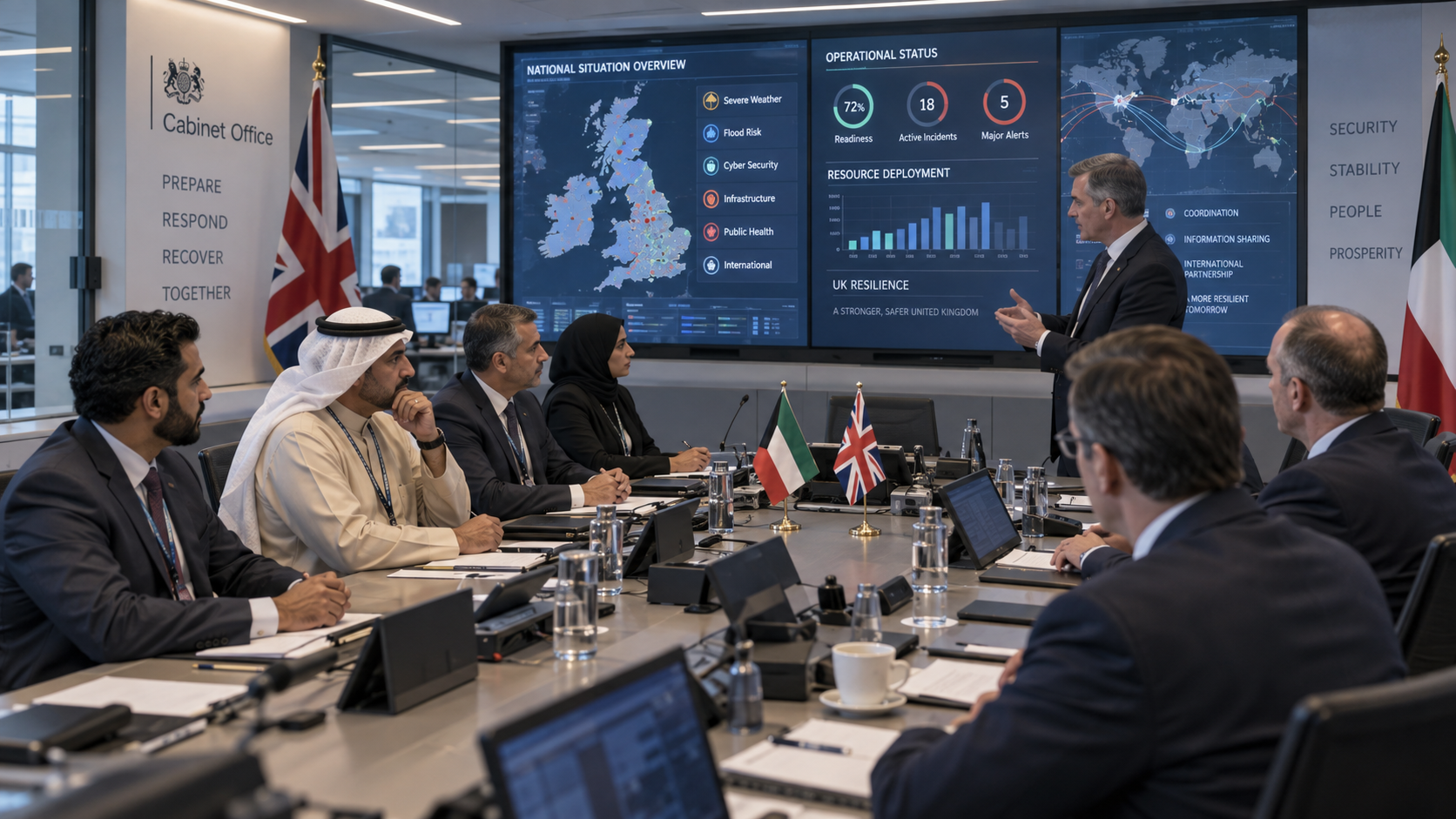
Kuwait’s team tasked with establishing the National Emergency, Crisis and Disaster Management Center, known as AMAN, has visited the United Kingdom’s Cabinet Office Briefing Rooms (COBR) as part of a wider effort to study international crisis-management systems.
The visit focused on how the UK coordinates government agencies during major emergencies, how information is brought together for senior decision-makers and how crisis-response structures are organized when incidents require cross-government action. A statement from the Kuwaiti team, carried by KUNA and published by Kuwait Times, said the discussions covered operational procedures, coordination mechanisms and lessons learned from previous emergencies.
The British side outlined key practices used in emergency and crisis management and discussed how government bodies share information and support decision-making during major incidents. The visit was not described as the adoption of a British model in Kuwait; rather, it was presented as part of AMAN’s program to review international experience and identify practices that could inform the development of Kuwait’s own national system.
Official UK guidance provides additional context for what the Kuwaiti delegation was studying. The UK government describes COBR as its central mechanism for strategic coordination during major emergencies that require urgent collective decisions. It brings together ministers, senior officials, experts and relevant agencies so that the government can establish a common understanding of an incident, coordinate resources and make time-sensitive decisions.
The UK Government Resilience Framework also describes COBR as a key mechanism for responding quickly to acute emergencies affecting national interests. It operates alongside other crisis-management and resilience structures rather than replacing the operational responsibilities of local responders and individual government departments.
The Kuwaiti team also reviewed the work of the UK Resilience Academy. According to the AMAN statement, the delegation examined how the academy develops the skills of leaders and personnel working in resilience, emergency management and crisis response through specialized training, professional qualifications and exercises.
The UK Resilience Academy, launched in 2025, is the British government’s central learning and development hub for the wider resilience community. Official UK material says the academy provides training and leadership development for central and devolved government, local authorities, resilience forums, voluntary organizations and the private sector. It also supports national exercising and professional standards for people working in emergency preparedness and response.
The two sides discussed expanding cooperation and exchanging expertise between Kuwait and the United Kingdom in emergency, crisis, disaster and risk management. According to the Kuwaiti statement, the British side expressed readiness to provide expertise that could support the establishment and development of AMAN.
AMAN operates under Kuwait’s Council of Ministers and has been tasked with developing a comprehensive national framework for emergency and disaster management. Its mandate includes coordinating national efforts, building an integrated risk-management system and strengthening preparedness and response capabilities.
That institutional role makes the UK visit relevant beyond a single training exchange. The practical questions examined at COBR — how agencies share information, how strategic decisions are coordinated, how leaders are trained and how exercises are used to test readiness — are central to building a national system capable of handling complex emergencies involving several government bodies at once.
Kuwait has already been using the AMAN establishment process to review domestic emergency procedures and coordination arrangements. The London visit extends that work by comparing Kuwait’s developing framework with a mature crisis-management system and a dedicated national resilience-training structure.
The available sources do not indicate that Kuwait and the UK signed a binding agreement during this visit, nor do they identify a timetable for completing the AMAN center. The confirmed outcome is the exchange of operational knowledge and a stated willingness to continue cooperation. Any future training program, formal agreement or structural change would require separate confirmation.
The AMAN statement was reported by KUNA and carried by multiple Kuwaiti outlets. Gulf Pulse also cross-checked the descriptions of COBR and the UK Resilience Academy against current UK government guidance. Those official UK sources support the institutional background described in this article while the details of the Kuwaiti delegation’s meetings remain based on the AMAN statement relayed by KUNA.