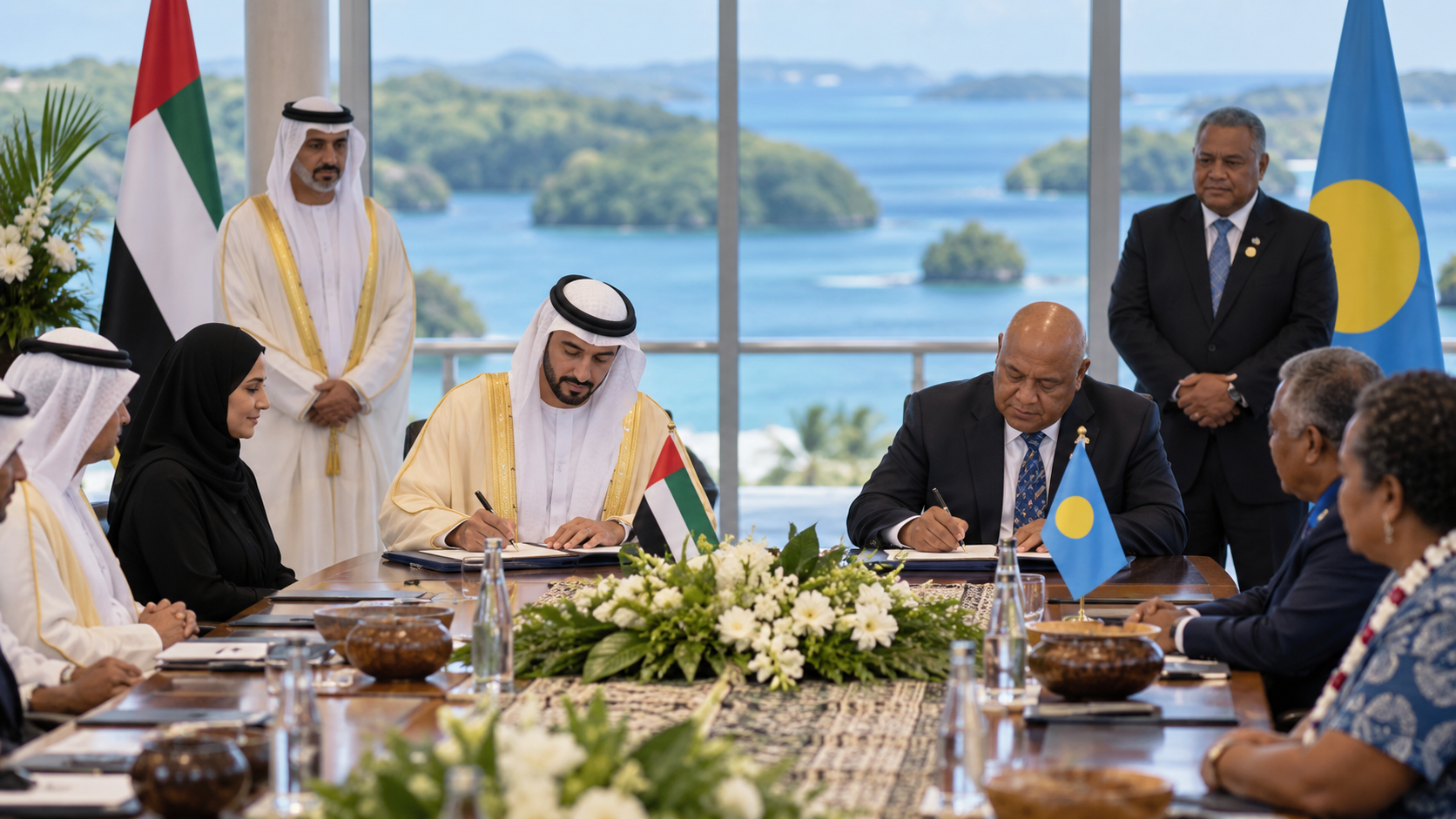
The United Arab Emirates has joined the Pacific Islands Forum as a Strategic Partner, formalizing a broader relationship with Pacific Island countries that the UAE says has developed through cooperation in renewable energy, climate resilience, education and sustainable development.
The decision was confirmed at the Pacific Islands Forum Leaders’ Retreat during the 55th Pacific Islands Forum Leaders’ Meeting in Koror, Palau, according to both the UAE Ministry of Foreign Affairs and Emirates News Agency.
The UAE joins 12 existing Strategic Partners listed in the official announcement: China, the United States, France, Germany, the United Kingdom, Canada, Japan, India, Indonesia, Singapore, South Korea and the European Union.
The announcement followed the participation of Noura bint Mohamed Al Kaabi, Minister of State, on behalf of UAE President Sheikh Mohamed bin Zayed Al Nahyan at the leaders’ meeting held in Koror from August 30 to September 4.
The UAE Ministry of Foreign Affairs said the new status builds on existing engagement with Small Island Developing States, particularly in renewable energy, climate resilience, education and sustainable development.
Strategic Partner status is expected to provide a more structured platform for dialogue with Pacific Islands Forum members and for cooperation in trade, investment, business partnerships, digital transformation, connectivity, climate resilience and the energy transition.
Al Kaabi said the recognition reflects years of cooperation with Pacific nations and a shared focus on sustainable development, while Omar Shehadeh, the UAE foreign minister’s envoy to Caribbean and Pacific states, described the status as opening additional avenues for collaboration and connectivity.
Those statements represent the UAE government’s description of the partnership’s objectives, and Gulf Pulse is not treating them as proof that specific trade or investment projects have already been agreed or financed.
The announcement does not identify a financial package, binding investment commitment or new bilateral treaty linked directly to Strategic Partner status, so any future commercial or development projects should be reported separately when formally confirmed.
The Pacific Islands Forum is the region’s principal political organization, bringing together Pacific governments for cooperation on regional priorities, while the Strategic Partner framework provides a channel for selected external partners to engage with the Forum and its members.
The UAE’s elevation therefore expands its institutional diplomatic presence in the Pacific but does not make it a full member of the Forum, a distinction that should remain clear in coverage of the announcement.
The National separately reported the recognition and described the status as creating additional opportunities for cooperation and trade, corroborating the UAE government’s account of the decision and its intended areas of engagement.
For Gulf readers, the development is relevant because it connects UAE foreign policy with Pacific priorities that overlap with Gulf interests, including renewable energy, climate adaptation, investment, digital connectivity and the transition of energy systems.
The verified core is that the UAE has been recognized as a Strategic Partner following a decision confirmed at the leaders’ retreat, while the practical scale and economic impact of the partnership will depend on projects, agreements and funding decisions that emerge later.